
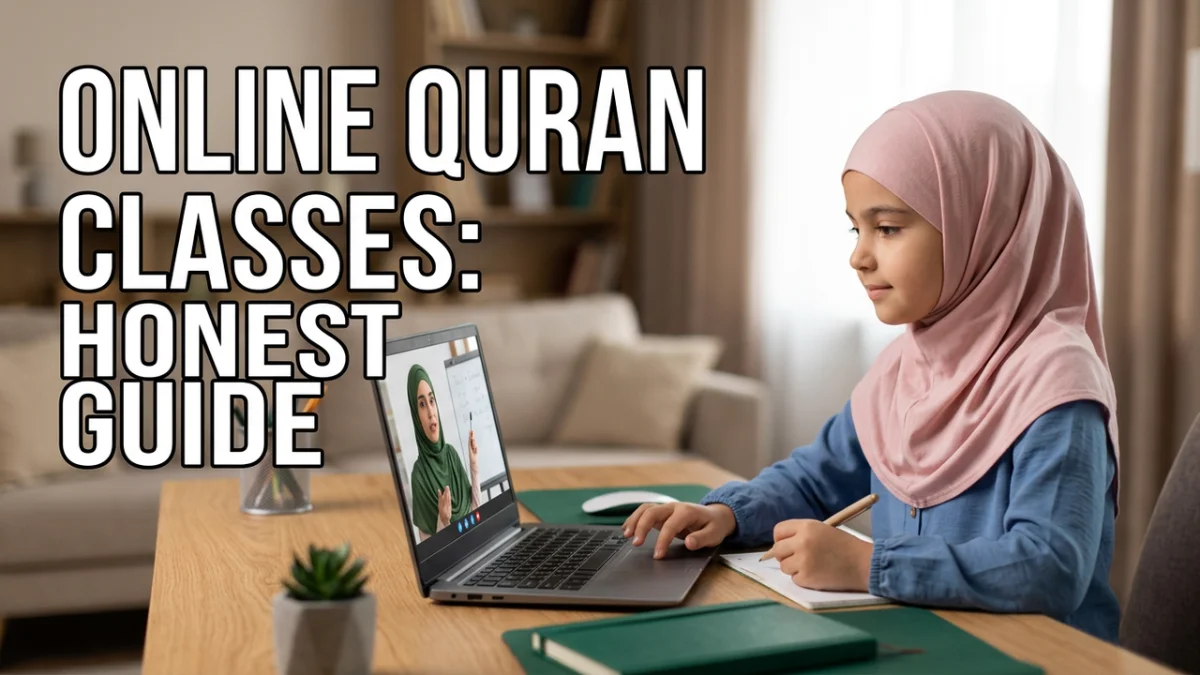
Online Quran Classes for Kids: An Honest Parent Guide
Most articles on this topic read like a sales brochure. This one is written by people who actually run the lessons, so it includes the parts academies usually leave out: what a session really looks like, what it costs, how long progress takes, and what to do when your eight-year-old suddenly decides Quran class is boring.
If you live in the USA, the UK, Canada or Australia, finding a qualified teacher nearby can be genuinely difficult. Online Quran classes for kids solve that. But not every programme is worth your money, and a bad first experience can put a child off for years.
So let’s go through it properly.
The short answer
Online Quran classes for kids are live one-to-one video lessons where a qualified teacher guides a child through Arabic reading, Tajweed and memorisation. Most children start between ages 4 and 7, take two to five sessions a week of 25 to 30 minutes each, and pay roughly 30 to 60 US dollars a month.

What are online Quran classes for kids, exactly?
An online Quran class for kids is a scheduled, live, one-to-one lesson delivered over video. The teacher shares a digital page of the Quran or Qaida, the child reads aloud, and the teacher corrects pronunciation in real time.
That last part matters more than anything else. Quran recitation is an oral skill. It cannot be learned from a recording or an app, because nobody is listening to catch the mistake before it becomes a habit.
Recorded videos and apps are useful support. They are not the lesson.
A proper programme also has a curriculum behind it. At Taqweem Academy, the usual path runs from Noorani Qaida for absolute beginners, into Nazra Quran reading, then on to the Master Tajweed Course and, for children who want it, Hifz.
What actually happens in a 30-minute lesson?
Here is the honest breakdown, because almost nobody publishes this.
Minutes 0 to 3. Salaam, a quick check that the audio is clear, and a look at last lesson’s notes. Good teachers start with a small win so the child feels capable.
Minutes 3 to 8. Revision. The child re-reads the previous page. This is where forgetting gets caught early.
Minutes 8 to 20. New material. The teacher reads a line, the child repeats, the teacher corrects. Slowly. Three or four lines is a normal amount for a beginner. Not a page.
Minutes 20 to 26. Practice on the new lines without the teacher modelling first.
Minutes 26 to 30. Homework is set: a short dua, and the teacher notes what to revise.
Thirty minutes sounds short. For a six-year-old, it is close to the limit of real concentration. Longer lessons usually mean a tired child and slower progress, not faster.
At what age should a child start Quran classes?
Between four and seven for most children, though there is no upper limit and no religious requirement to start at a particular age.
Young children pick up Arabic sounds like the heavy letters and the throat letters far more easily than adults do, simply because their ears are still flexible about unfamiliar sounds. Starting at five is easier than starting at eleven.
But readiness matters more than the number. A child is ready when they can sit for fifteen minutes, follow a simple instruction, and recognise letters in their own first language.
If your child is not there yet, Basic Duas for Children and Islamic Studies for Kids are gentler starting points. Both build the habit of a regular Islamic lesson without the pressure of decoding Arabic script.
Is screen time for online Quran lessons a problem?
Live, two-way lessons are not the same thing as passive screen media, and the research treats them differently.
The American Academy of Pediatrics draws an explicit line here. In its policy statement Media and Young Minds, video chatting is singled out as an exception to its general screen limits for the very young, because a real person is responding to the child in real time.
A Quran lesson is exactly that: a responsive adult, a task, and immediate feedback. It sits closer to a phone call with grandma than to an hour of cartoons.
That said, keep it sensible. One short lesson a day, in a quiet room, with the device on a table rather than in the child’s lap.
How much do online Quran classes for kids cost?
Expect 30 to 60 US dollars a month for two to five one-to-one sessions a week. Group classes run cheaper. One-to-one with a highly qualified Hafiz or an Ijazah holder runs higher.
Taqweem Academy publishes its rates openly on the plans page rather than hiding them behind a form. For USA and Canada families, the range starts at 30 dollars a month for three classes a week and goes to 55 dollars for five, all one-to-one, all 30 minutes.
Three things quietly change the price at any academy:
- One-to-one versus group. Group lessons can be half the cost and roughly half the individual attention.
- Teacher qualification. A teacher with a formal Ijazah in recitation costs more than a general Quran teacher, and for Hifz that difference is usually worth paying.
- Session length and frequency. Five short sessions a week beats two long ones for retention, and often costs less than you expect.
Be wary of any academy that will not tell you the price until you have handed over a phone number.
Online classes, local madrasa or a home tutor?
There is no single right answer. It depends on what your family actually needs.
| Online one-to-one | Local madrasa | In-home tutor | |
|---|---|---|---|
| Typical cost | 30 to 60 USD/month | Often free or donation-based | 25 to 60 USD per hour |
| Attention per child | Full | Shared with 10 to 30 children | Full |
| Teacher choice | Wide, including female teachers | Whoever is available locally | Limited to your area |
| Travel | None | Two trips per session | None |
| Scheduling | Flexible, evenings and weekends | Fixed timetable | Fixed, plus travel time |
| Social contact with other Muslim kids | Low | High | None |
| Parent can observe | Easily | Rarely | Yes |
The honest trade-off: online wins on attention, cost and convenience. The masjid wins on community. Plenty of families do both, using weekend madrasa for friendship and online lessons for the actual reading skill.
What progress can you realistically expect?
Assume three 30-minute lessons a week and reasonable homework. These are typical ranges, not promises, because children differ enormously.
- Month 1. Recognises most Arabic letters in isolation. Knows the short vowel marks. Still slow.
- Month 3. Joins letters into words. Reads simple Qaida lines without prompting. Confidence jumps here, and this is where most children stop wanting to quit.
- Month 6. Finishes or nearly finishes Noorani Qaida. Begins reading short surahs.
- Month 9 to 12. Reads from the Quran itself, haltingly at first. Basic Tajweed rules are being applied rather than just recited.
- Year 2 onward. Fluent Nazra reading. Ready for proper Tajweed study or a structured Hifz plan.
If a child is nine months in and still cannot join letters, the problem is almost never the child. It is usually too few sessions, no homework, or a teacher who is moving on before the previous step is solid.
How do you check a teacher is genuinely qualified?
Ask direct questions before you commit. A good academy will answer all of these without hesitating.
- Do you have an Ijazah, and in which recitation? An Ijazah is a certified chain of transmission. It is the clearest single credential in this field. Taqweem runs an Ijazah course itself, so this is a fair thing to ask about.
- How long have you taught children specifically? Teaching adults and teaching a restless seven-year-old are different jobs.
- Can my child have a female teacher? For many families this is not negotiable. Any serious academy offers both, and Taqweem’s teaching team includes male and female teachers.
- What happens if my child and the teacher do not click? The answer should be a straightforward swap, not a lecture.
- Can I sit in on lessons? Yes should be the only acceptable answer.
Then use the trial. Watch the first lesson yourself. You will know within ten minutes whether the teacher is patient with a child who gets it wrong.
Making the timetable work across time zones
Pakistan is UTC+5. That means a teacher’s evening is a US family’s morning, and a teacher’s early morning is a US family’s evening.
In practice this works out well:
- US East Coast. After-school slots between 4 pm and 8 pm ET land at 1 am to 5 am in Pakistan, so ask specifically whether night-shift teachers are available. Many academies have them. Weekend mornings are easier.
- UK. After-school at 5 pm GMT is 10 pm in Pakistan. Comfortable for both sides.
- Australia. Early evening in Sydney is early afternoon in Pakistan. The easiest match of all.
Book the same slot every week if you can. Children treat a fixed Tuesday and Thursday at 6 pm as a normal part of life. A slot that moves around every week quietly becomes optional.
When your child does not want to go
This happens to nearly every family, usually somewhere between weeks four and ten. The novelty has worn off, and the work has become work.
A few things that actually help:
Shorten the lesson before you cancel it. Fifteen focused minutes is better than a cancelled thirty.
Ask the teacher to go back a page. Resistance is very often quiet embarrassment at not understanding something from two lessons ago.
Attach the lesson to something the child already likes. Reading right before a favourite meal or activity works better than reading straight after school.
Let them hear beautiful recitation outside lesson time. Our post on the effect of listening to Quran recitation covers why this changes a child’s relationship with the text.
And tell the teacher. A teacher who knows a child is struggling will change the approach. A teacher who is not told will keep doing the thing that is not working.
How to start, step by step
- Decide the goal. Reading fluently, memorising, or understanding meaning. These need different courses. Browse the full course list if you are unsure.
- Pick a realistic schedule. Three 30-minute slots a week is the sweet spot for most children.
- Book a free trial. Taqweem gives three free trial classes with no card required, which is enough to judge a teacher properly.
- Sit in on the first lesson. Watch how the teacher handles a mistake.
- Confirm teacher preference. Male or female, and the time slot you want to keep.
- Set up the space. Quiet room, table, headphones, device charged. It takes five minutes and prevents half of all lesson problems.
- Review after four weeks. Ask the teacher what the child can do now that they could not do a month ago. If nobody can answer that, something needs to change.
Questions about any of this can go straight to the team on the contact page, and there are printable practice materials in the resources section.
Where to go from here
Online Quran classes for kids work when three things line up: a patient, qualified teacher, a schedule the family can actually keep, and a parent who checks in without hovering. The technology is the easy part.
Start small. Three short lessons a week, the same days every week, for two months. That is enough to know whether it is working, and it is a far more useful test than reading another comparison article.
If you want to see how it feels before deciding anything, the free trial costs nothing and commits you to nothing. And if your child is starting from zero, our guide on how to start learning the Quran is a good companion to this one.
Frequently asked questions
At what age can my child start online Quran classes?
Most children start between four and seven years old. What matters more than age is whether the child can sit still for about fifteen minutes and follow simple instructions. There is no upper age limit, and plenty of children begin at ten or twelve and do very well.
How many classes per week does a child need?
Three 30-minute sessions a week suit most beginners. Two is workable, but progress is slower. Five short sessions beat two long ones, because Arabic reading is built through frequent repetition rather than long single sittings.
Can Tajweed really be taught over video?
Yes, provided the lesson is live and one-to-one. Tajweed depends on the teacher hearing each letter and correcting it immediately, which a live video call allows. It cannot be learned properly from recorded lessons or an app, because nothing is listening to the child.
How much do online Quran classes for kids cost?
Typically 30 to 60 US dollars a month for two to five one-to-one sessions a week. Group classes cost less, and teachers holding an Ijazah cost more. Taqweem Academy lists its plans publicly, starting at 30 dollars a month for three classes a week.
Can I choose a female Quran teacher for my daughter?
Yes. Any established academy offers both male and female teachers, and you should be able to state your preference before the trial rather than after. If an academy cannot guarantee this, treat it as a warning sign.
What equipment do we need?
A laptop or tablet, a stable internet connection, headphones, and a quiet room. A tablet with a stylus helps for writing practice but is not required. Nothing needs to be bought specially.
How long before my child can read the Quran fluently?
With three sessions a week, most children finish Noorani Qaida in six to nine months and begin reading the Quran itself around the nine to twelve month mark. Fluent Nazra reading usually comes somewhere in the second year.
What if my child does not get along with the teacher?
Ask for a different teacher. This is normal, and no reasonable academy will make it awkward. Personality fit matters a great deal with children, and a teacher who suits one child may not suit their sibling.


