
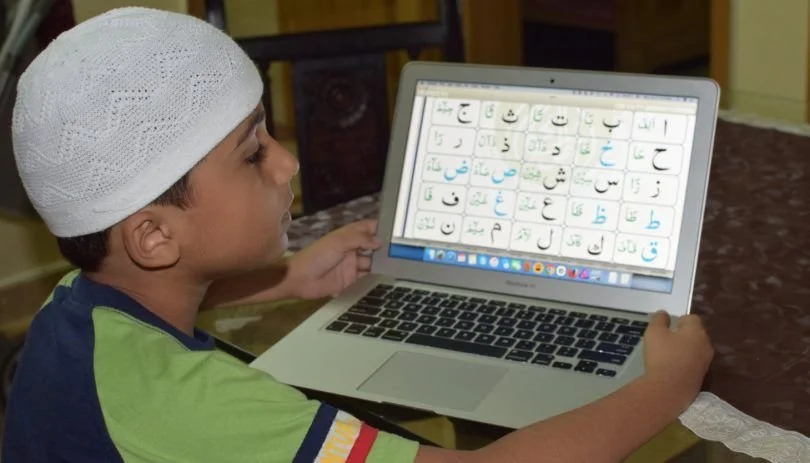
The basis for correct Quranic recitation is the Noorani Qaida Course, which concentrates on enabling students to gain the fundamental abilities required to accurately read Arabic letters and syllables.
This course is designed to walk students methodically through the core of Noorani Qaida, therefore providing the perfect beginning point for anyone eager to study the Arabic alphabet and get ready for advanced Quranic studies.


01 — Book Your Free Trial
Complete the short registration form and select your preferred course and timing.
02 — Meet Your Teacher
We assign a suitable male or female Quran teacher based on your requirements.
03 — Attend Your Free Trial Classes
Join three live trial classes and experience our teaching method before enrolling.
04 — Begin Your Learning Plan
Choose your monthly plan and continue with personalised one-to-one Quran classes.
We made the Quran easy for one purpose, to remember Him. Is there anyone who'll take up the challenge and remember?
[54:17]
Jacie M
Fatima A
Sadia N
Mohammed H
All classes are conducted live through one-to-one video sessions with a qualified Quran teacher.
Yes. Qualified female Quran teachers are available for children, sisters and adult women.
A standard class is approximately 30 minutes. Longer sessions may be arranged according to the student’s course and requirements.
Yes. We offer flexible timings for students from the USA, UK, Canada, Australia, Europe and other countries.
Students attend three live trial classes to meet their teacher, experience the teaching method and receive an initial learning assessment.
Students can attend classes using a laptop, tablet or smartphone with a stable internet connection.
| Arabic Letters and Their Sounds | Short Vowels (Harakats) | Long Vowels (Madd) | Sukun and Tanween | Letter Combinations | Connecting Letters | Special Arabic Letters | Practice with Simple Words | Common Quranic Phrases |
|---|---|---|---|---|---|---|---|---|
| Introduction to the 29 Arabic letters and their individual sounds. | Learn the three short vowels (Fatha, Kasra, Damma) and their impact on pronunciation. | Explore long vowels and their role in extending the pronunciation of words. | Understand Sukun (no vowel) and Tanween (double vowel sound) and how they affect pronunciation. | Learn how Arabic letters combine to form syllables and words. | Study how to connect Arabic letters to form proper words in writing. | Recognize unique Arabic sounds and letters, including those with specific rules. | Reinforce learning by practicing reading simple words formed from these sounds and combinations. | Introduce commonly used words and phrases from the Quran to enhance understanding. |
m
Join caring and qualified Quran teachers in live one-to-one classes designed around your child’s learning level and schedule.