
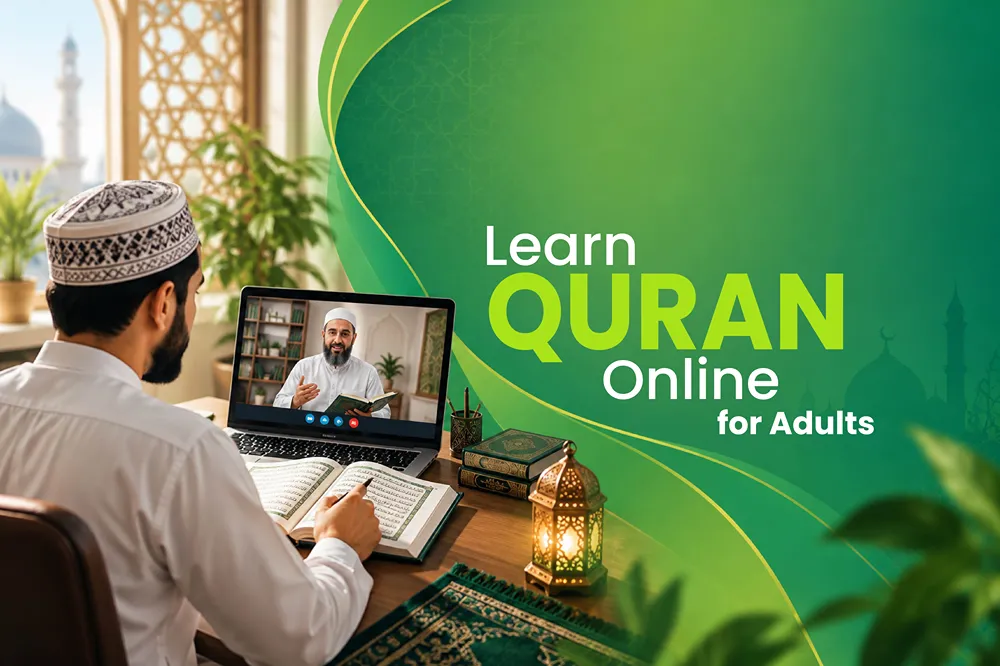
Many adults want to learn Quran online but keep putting it off. Some feel embarrassed to start from zero. Others believe they missed their chance when they were young. If that sounds like you, relax. Plenty of people begin reading Arabic letters in their thirties, fifties, or even later, and they do it from a quiet corner of their home.
This guide shows you where to start, what to learn first, and how to pick a good teacher. It also gives you a simple daily routine. Everything is written in plain words for real adults with jobs, families and busy evenings.
Where Should Adults Start to Learn Quran Online?
Adults should start with Noorani Qaida, a beginner course that teaches Arabic letters, vowel marks and basic reading. After that, move to Tajweed, then fluent Quran reading, then meaning and translation. Learn with a qualified teacher who listens and corrects you in live one to one lessons.
The order matters more than most people think. Reading comes before memorizing. Correct sounds come before speed. And a teacher’s ear comes before any app.
Noorani Qaida is a beginner reading primer. It starts with the Arabic letters and their sounds. Then it moves through short vowels, long vowels, sukun, tanween and joined letters. Many adults feel it is a children’s book, so they skip it. That is the most common early mistake. It looks simple, but everything else in Quran reading stands on it.
What Does It Mean to Learn Quran Online?
To learn Quran online means to take live lessons over video with a teacher who hears you recite and corrects you as you read. You sit at home with a phone, tablet or laptop. The teacher shows the page on screen, you read aloud, and mistakes are fixed on the spot.
That live correction is the whole point. A recorded video can explain a rule, but it cannot hear you get it wrong. You can also schedule lessons around your work, which is why so many adults choose this route over a fixed evening class across town.

Is It Too Late to Learn Quran as an Adult?
No, it is not too late. Adults start at every age, and they bring strengths that children do not have. You know why you are learning. You can follow instructions. You can plan your week and stick to a routine.
What adults often lack is patience with themselves. Some Arabic sounds do not exist in English, Urdu or your first language, so your mouth needs time to learn them. Expect a few weeks of awkward sounds. That is normal, not a sign that you are behind.
If you are a new Muslim, or you are returning to Quran study after many years away, the same plan works for you.
Common Fears Adults Have When They Learn Quran Online
Fear of embarrassment is the biggest one. Teachers meet adult beginners all the time, and online lessons happen in your own room. Nobody else is listening.
Fear of being slow comes next. Progress is not a race. A child may pick up sounds faster, but an adult can practice with more focus and understand why each rule matters.
The third fear is lack of time. Short daily practice usually works better than one long session a week. Your tongue and ears learn through repetition, and repetition needs frequent contact.
Do You Need Arabic to Learn Quran Online?
No. Reading the Quran and speaking Arabic are two different skills. You can learn to read the letters and recite correctly without knowing what every word means. Later you can add a translation course to understand the message.
Be honest with yourself about one thing, though. Reading without meaning is a starting point, not the finish line. Plan to add meaning once your reading is steady.
A Simple Plan to Learn Quran Online for Adults
This plan has five stages. Move to the next stage when the current one feels steady. It does not need to feel perfect.
Stage One: Noorani Qaida for Quran Reading Basics
Your first goal is to recognize every Arabic letter and say its sound. Then you learn how vowel marks change those sounds. The Noorani Qaida course at Taqweem Academy covers this in order, from single letters to joined syllables and simple words.
Arabic Letter Shapes in the Quran
Most Arabic letters change shape depending on where they sit in a word. A letter at the start looks a little different from the same letter in the middle or at the end. Adults often trip on this. Ask your teacher for a shapes chart and read it aloud every day.
One small exercise helps a lot. Pick five letters each day, say each one three times, then say them again with your eyes closed to test yourself.
Short and Long Vowels in Quran Reading
The three short vowel marks are Fatha, Kasra and Damma. They change how a letter sounds. Long vowels stretch that sound. Practice each one slowly, and do not rush to read whole lines yet.
Stage Two: Tajweed for Correct Quran Recitation
Tajweed is the set of rules for pronouncing each Quran letter correctly. The word carries the idea of making something excellent, and the Wikipedia page on Tajwid explains it as giving every letter its right in recitation. Scholars differ on how strictly some finer rules apply, so ask your teacher which rules are must haves and which are refinements.
Makharij: Where Quran Letters Come From
Makharij means the points of articulation. Every Arabic letter has an exit point in the throat, tongue, lips or nose. Learn these points and you will fix many errors at the source. A good example is Qaf and Kaf, two letters that many beginners mix up.
Madd and Ghunna in Quran Reading
Madd means stretching a sound for the right length. Ghunna is a nasal sound held for a short count. Both give Quran recitation its rhythm. Getting the length right takes a teacher’s ear, because you cannot easily hear your own timing.
Stage Three: Nazra, Reading the Quran Fluently
Nazra means reading the Quran from the Mushaf. Start with short surahs such as Surah Al Fatihah, then increase slowly. Taqweem Academy has a Nazra Quran course for kids, adults and females that focuses on fluency and correct pronunciation. Read a small portion many times rather than a big portion once.
Stage Four: Quran Translation and Meaning
Once you can read with fair confidence, add meaning. A Quran translation course helps you connect the words to their message. Even a few minutes of meaning each week makes recitation feel more personal.
Stage Five: Hifz and Deeper Quran Study
Memorization is optional at this point, but many adults begin with short surahs from Juz Amma. A steady revision habit matters more than speed. Taqweem Academy describes its Hifz program, with daily revision and regular assessments, in this article on online Quran learning.
If you also want to understand the language itself, the Arabic language course is a natural next step.
How to Choose a Teacher When You Learn Quran Online
Choose a teacher who is trained in Tajweed, teaches live one to one, corrects you as you read, and offers a free trial. A good teacher listens more than they talk and gives you clear homework.
Qualifications matter, but so does fit. You will spend many hours with this person, so you need to feel comfortable reading badly in front of them.
Questions to Ask in a Free Quran Trial Class
- Will you correct me while I read, or only at the end?
- Can I choose a male or female teacher?
- What will I be able to do after the first month?
- How will you track my progress?
- Can I move my class time if my work schedule changes?
If the answers are vague, keep looking.
One to One or Group Quran Classes for Adults?
One to one lessons give you the most speaking time and the most correction. Group classes may cost less, but you read less often and your mistakes can go unnoticed. Adults who feel shy usually do better one to one.
Here is a simple test. During your trial, notice how much of the lesson you spend reciting. If the teacher does most of the talking, you are watching, not practicing. Aim for a lesson where your voice fills most of the time.
Many sisters prefer a female teacher, and many brothers prefer a male teacher. That is a normal preference. Taqweem Academy pairs each student with a qualified male or female teacher, so you can choose what makes you comfortable.
What to Expect in Your First Quran Lesson
In a first lesson, most teachers begin by listening. You may be asked to say a few letters or read a short line so the teacher can see your level. Then you get a small goal for the week. Do not try to impress anyone. A first lesson is a checkup, not an exam, and the more honestly you read, the better your plan will be.
What You Need at Home to Learn Quran Online
A Quiet Space and Simple Tools for Quran Lessons
You do not need much. A phone, tablet or laptop with a working camera, a stable internet connection, and a pair of headphones with a microphone are enough. A quiet corner and a small notebook complete the setup.
Test your sound before the first class. If the teacher cannot hear the small differences in your pronunciation, the lesson loses its value.
A Mushaf That Works for Adult Quran Learners
Choose a Mushaf with clear, large print. Some adults like a copy with color coded Tajweed marks. Ask your teacher first, because some teachers prefer a plain Mushaf so your eyes learn the letters themselves. Keep using the same copy so the page layout becomes familiar.
Build a Daily Habit to Learn Quran Online
Practice for 15 to 20 minutes every day at the same time, and record yourself once a week. Habit beats motivation. Motivation fades by week three. A fixed time does not.
Tie your practice to something you already do, such as the time right after Fajr or right after dinner. A habit attached to an existing routine lasts longer than one that floats around your day.
A Simple Weekly Quran Practice Schedule
| When | What to Do |
|---|---|
| Lesson days | Attend class, then repeat the lesson for 10 minutes the same day |
| Between lessons | Read the assigned lines aloud for 15 to 20 minutes |
| Once a week | Record one minute of your reading and listen back |
| One free day | Rest, or revise old lessons gently |
The recording step is the one most adults skip, and it is the most useful. When you listen back, you will hear errors that you could not hear while you were reading.
Mistakes That Slow Adults Down When They Learn Quran Online
Skipping Noorani Qaida Too Early in Quran Learning
Adults often jump straight to the Mushaf because it feels more serious. Weak letter recognition then shows up on every page. Go back and finish the basics.
Repeating the Same Quran Mistake Without Correction
If you practice a wrong sound for weeks, it becomes a habit. Practice only what your teacher has checked. For anything else, ask first.
Comparing Yourself With Other Quran Students
Your pace depends on your first language, your schedule and how often you practice. Compare yourself only with the you of last month.
How Taqweem Academy Helps Adults Learn Quran Online
Taqweem Academy is an online Quran academy that teaches children and adults through live one to one video lessons. Each student is paired with a qualified male or female teacher and follows a plan based on their own level. The academy’s teachers are trained in Tajweed, Qira’at and Islamic studies.
Classes are booked around your time zone, and the first three lessons are free. The academy says there is no registration fee and no credit card is needed for the trial. Results depend on your practice, and no academy can promise a date when you will finish. What a good academy can give you is structure, correction and a plan.
Quran Courses at Taqweem Academy for Adult Learners
The courses page lists Noorani Qaida, Nazra, Tajweed, Hifz, translation and Arabic. For a shorter overview of the first steps, read the academy’s guide on how to start learning the Quran or its page on online Quran classes for beginners.
How to Book a Free Quran Trial Class
Open the registration page and fill in your name, contact details, country and the course you want. Tell the team your current level and the times that suit you. Then attend your trial and use the questions from this guide to test the fit.
Ready to Learn Quran Online for Adults? Take the First Step Today
The path is simple. Begin with Noorani Qaida, add Tajweed, read fluently, then add meaning. Practice a little every day and choose a teacher who listens. Do not wait until you feel ready, because the lesson itself is what makes you ready.
If you want live help, visit Taqweem Academy, book a free trial and read your first page aloud this week.
FAQs About Learning Quran Online for Adults
1. Can I learn Quran online from zero as an adult?
Yes. Many adult learners start with no Arabic at all. You begin with Arabic letters and their sounds, then move to vowels, joined letters and simple words. A live teacher guides each step and corrects your pronunciation.
2. How long does it take to learn Quran online for adults?
There is no fixed timeline. Your speed depends on how often you practice, your first language and the quality of correction you receive. Steady practice of 15 to 20 minutes a day gives most learners the best chance of visible progress.
3. Do I need to learn Arabic to read the Quran?
No. Reading the Quran needs letter recognition, vowels and Tajweed, not full Arabic. You can add Arabic or a translation course later to understand the meaning.
4. Is Tajweed necessary when I learn Quran online?
Tajweed is the science of correct pronunciation, and learning it is strongly encouraged. Scholars differ on how strictly some finer rules apply. Ask your teacher to explain which rules are essential for you and which are refinements.
5. Can I learn Quran online while working full time?
Yes. Online lessons can be booked around your work hours, and short daily practice fits into a busy day. Choose a teacher who can move class times when your schedule changes.
6. Can women learn Quran online with a female teacher?
Yes. Taqweem Academy offers qualified male and female teachers, so women can choose a female teacher for live one to one lessons. Tell the academy your preference when you register.
7. Does Taqweem Academy offer a free Quran trial for adults?
Yes. Taqweem Academy offers three free trial lessons. The academy says there is no registration fee and no credit card is needed. Use the trial to check the teacher’s style and your comfort level.


